Source GHK-Cu peptides in wholesale quantities from a Canadian distributor committed to quality-focused bulk peptide supply.
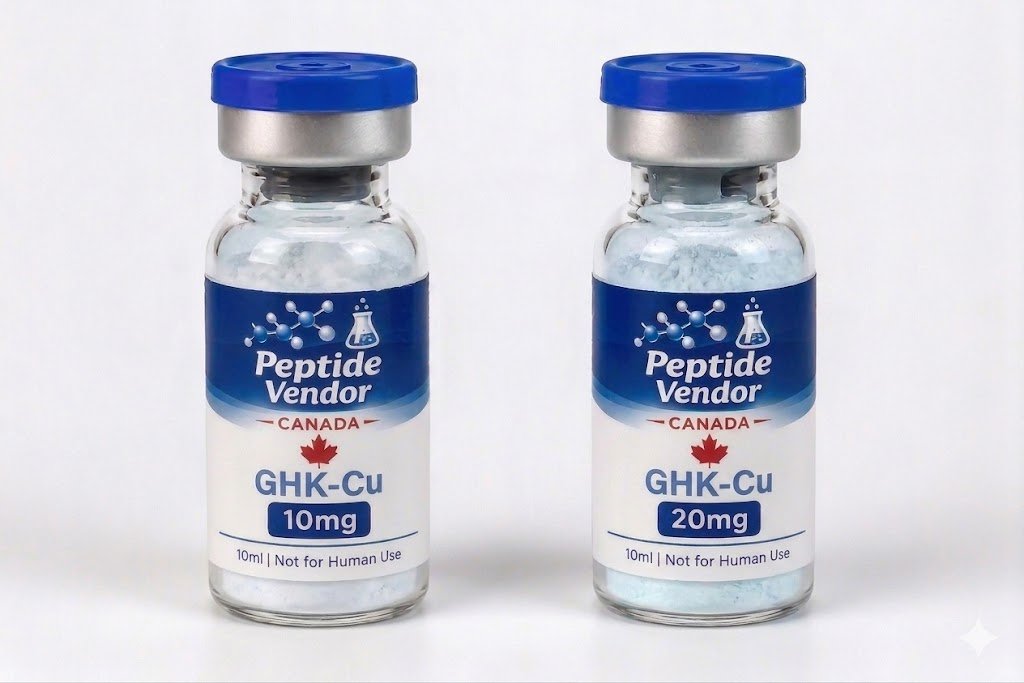
Consistency in peptide research requires more than inventory. It demands a GHK-Cu wholesale supplier who understands that copper complex stability, endotoxin levels, and batch-to-batch reproducibility determine study outcomes. In Canada, research institutions face unique logistics challenges: cold-chain integrity across provincial lines, customs documentation for imported peptides, and verification of synthesis claims.
The naturally occurring tripeptide glycyl-L-histidyl-L-lysine (GHK) binds copper(II) to form GHK-Cu, a complex with documented biological activities including angiogenesis support, tissue remodeling, and anti-inflammatory effects. A 1988 abstract in FEBS Letters (accessible via Harvard’s ADS system: 1988FEBSL.238..343M) first described GHK’s copper-binding properties. Today, researchers rely on bulk peptide solutions to investigate GHK-Cu across multiple models: from neuroinflammation in Alzheimer’s research to dermal wound healing.
wholesale Peptide sourcing:
- Single-lot purchases eliminate inter-batch variability
- Volume pricing reduces per-gram costs by 40–60%
- Direct supplier relationships enable custom synthesis (e.g., longer sequences like GHKGHK or GHKGHKGHK, as characterized by Kennesaw State University mass spectrometry studies: DigitalCommons@Kennesaw State University)
BULK GHK-CU Distributor
Understanding current research use cases helps procurement teams forecast bulk peptide solutions needs. Below is a summary of recent peer-reviewed studies, each supporting distinct applications.
| Research Focus | Model | Key Finding | Source |
|---|---|---|---|
| Alzheimer’s disease | 5xFAD transgenic mice (4–7 months old) | Intranasal GHK-Cu (15 mg/kg, 3x/week for 12 weeks) delayed cognitive impairment, reduced amyloid plaques, and lowered MCP-1-mediated inflammation in frontal cortex and hippocampus. | PMC: 12323558 |
| Brain aging resilience | Aged C57BL/6 mice (20–22 months) | Daily intranasal GHK-Cu for 8 weeks enhanced spatial memory (Y-maze and Box Maze tests), decreased axonal damage marker NFL-1, and reduced neuroinflammation (MCP-1). Sex-dependent effects observed. | PMC: 10680828 |
| Acute wound healing | Human clinical trial (NCT07437586, Phase 2, active, enrolling 60 participants) | Topical GHK-Cu gel versus vehicle on standardized punch-biopsy wounds. Primary outcome: time to complete re-epithelialization. | ClinicalTrials.gov: NCT07437586 |
| Copper complex characterization | In vitro mass spectrometry | GHK, GHKGHK, and GHKGHKGHK synthesized via SPPS; copper binding confirmed via m/z peaks ([M+H]+ at 341, 662, 984 respectively). | DigitalCommons@Kennesaw State University |
| Transdermal delivery | Cosmetic formulation (patent) | Supramolecular GHK-Cu nano-composite (myr-(RHK)3-[GHK-Cu]) self-assembles into micelles for targeted skin cell delivery. | PubChem Patent: CN-117414310-A |
Bottom line for procurement: If your lab is replicating Alzheimer’s, aging, or wound-healing studies, you require GHK-Cu wholesale quantities measured in grams, not milligrams. One 3-month mouse study at 15 mg/kg for 20 mice consumes approximately 270 mg of peptide. Scale that to multiple cohorts, and bulk ordering becomes non-negotiable.
3.1 Purity and Identity
- Request: HPLC chromatogram showing ≥98% purity
- Request: Mass spectrometry confirmation (expected [M+H]+ = 341.4 m/z for GHK; GHK-Cu complex shows characteristic copper isotope pattern)
- Reference: The TopicalPdb database (IIIT Delhi) lists GHK-Cu as Entry ID 1612, noting its use as a copper carrier peptide for wound healing and anti-aging applications: TopicalPdb Entry 1612
3.2 Copper Complexation Verification
- Why it matters: Unbound copper ions are toxic above 35 mg/kg in mice (as noted in the 2024 Alzheimer’s study). In GHK-Cu, copper makes up approximately 14% of molecular weight.
- Request: Inductively coupled plasma mass spectrometry (ICP-MS) confirming copper content within 13–15% range.
3.3 Endotoxin Levels
- For in vivo studies: Endotoxin must be <1.0 EU/mg
- Request: Limulus amebocyte lysate (LAL) test results
3.4 Stability and Storage
- Standard recommendation: Store lyophilized GHK-Cu at -20°C or -80°C, desiccated
- Request: Accelerated stability study data (e.g., 4 weeks at 40°C, 75% RH as described in the TopicalPdb entry for niosome-formulated GHK-Cu)
3.5 Chain of Custody
- For Canadian imports: Certificates of origin, customs declaration support, and end-user declaration forms
SECTION 4: FREQUENT ASKED QUESTIONS
Q: What is the typical lead time for bulk GHK-Cu orders to Canadian research facilities?
A: From a responsive GHK-Cu wholesale supplier, allow 10–14 business days for synthesis, QC release, and cold-chain shipping to major Canadian hubs (Toronto, Vancouver, Montreal, Calgary).
Q: Can you supply GHK-Cu in custom packaging (e.g., 500 mg/vial, 1 g/vial)?
A: Yes. Bulk peptide solutions can be aliquoted into research-friendly vials under inert gas. Discuss your specific needs with our logistics team.
Q: Do you provide documentation for animal care committee submissions?
A: Absolutely. We supply Certificate of Analysis, MSDS, and any stability data required for your Animal Use Protocol.
GHK-CU WHOLESALE CANADA
We are not a peptide manufacturer. We are a Canadian-focused logistics partner applying beverage-grade supply chain rigor to bulk peptide solutions. What does that mean for you?
- Temperature-controlled shipping: Same protocols used for pharmaceutical-grade beverages applied to peptide preservation
- Transparent documentation: No hidden lot numbers or missing COAs
- Responsive wholesale pricing: Volume discounts starting at 5 grams
- Custom synthesis coordination: For modified sequences (e.g., GHKGHK, amidated variants, or the myristoylated supramolecular complexes described in patent CN-117414310-A)
When you need a GHK-Cu wholesale supplier who treats research integrity as seriously as you do, contact our peptide logistics division. We’ll provide references, sample COAs, and a procurement timeline tailored to your next study.
Disclaimer for Google & compliance: This content is for informational and research procurement purposes only. GHK-Cu is not approved for human therapeutic use in Canada or the United States except as an investigational product in registered clinical trials (e.g., NCT07437586). Zagob Beverage B.V. supplies peptides for in-vitro and animal research only, not for human consumption. Researchers must comply with all applicable Canadian laws and institutional guidelines.